

Starting February 1, 2026, millions of Kenyan workers will notice a smaller pay-packet effect thanks to an ongoing ramp-up of National Social Security Fund (NSSF) contribution limits under the phased implementation of the NSSF Act, 2013. While the contribution rate itself – 6 per cent of pensionable earnings each for employer and employee remains unchanged, the portion of your salary that counts as pensionable is expanding. That means more of your income will be subjected to mandatory deduction
What’s Changing in 2026?
Under the existing arrangement, both workers and employers contribute six per cent of “pensionable earnings” to NSSF each month. How much of your salary is considered pensionable is determined by two thresholds:
- Tier I (Lower limit) – compulsory portion
- Tier II (Upper limit) – the higher portion that also attracts NSSF deductions
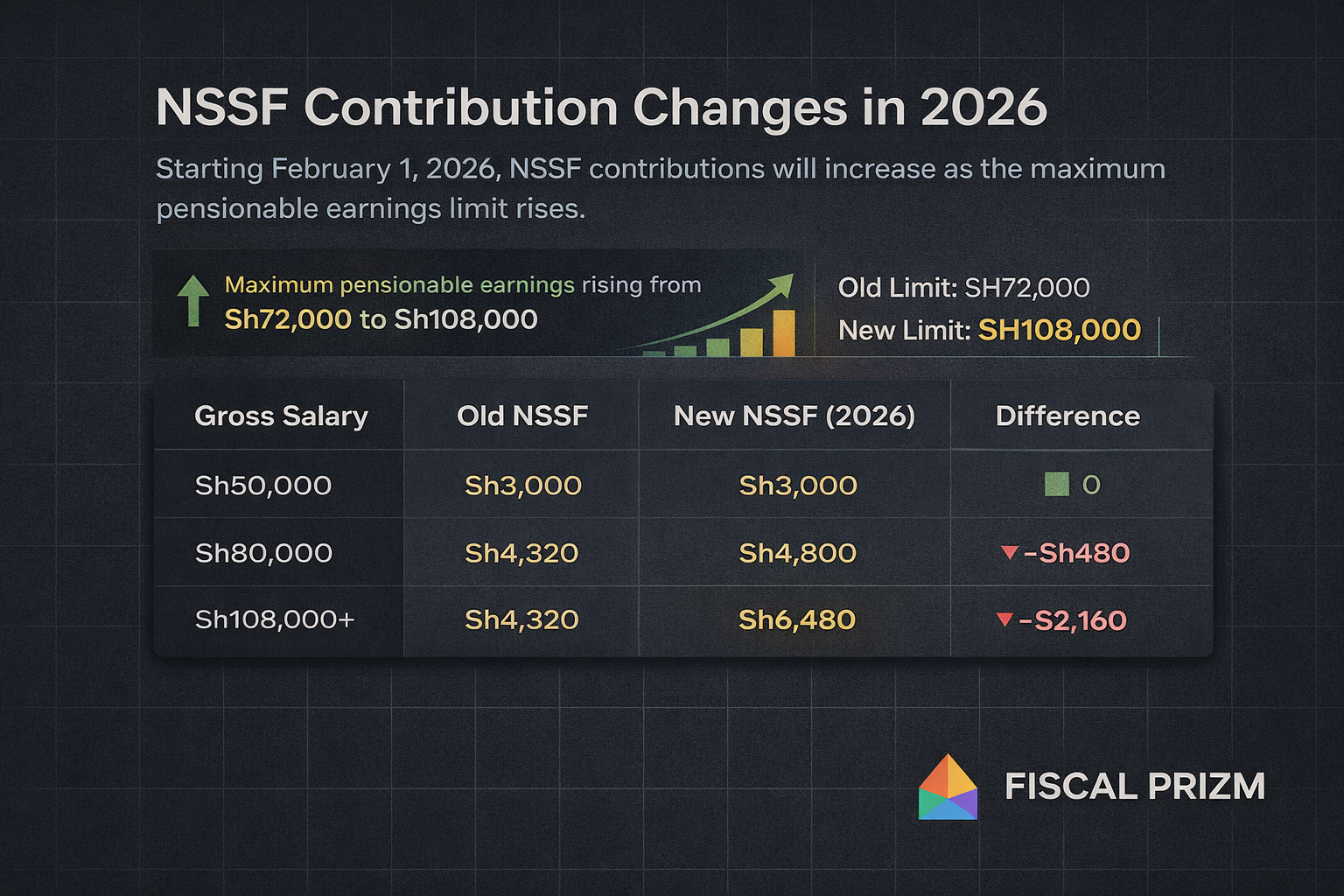
In 2025, the lower and upper limits were set at Sh8,000 and Sh72,000, respectively. Beginning February 2026, these rise to:
✔ Tier I (Lower limit): Sh9,000
✔ Tier II (Upper limit): Sh108,000
This means higher earners now have a much larger slice of their gross income subject to the 6 per cent contribution.
Who Is Affected and How?
1. Low & Middle Income Earners
If your monthly salary already fell fully within the previous pensionable range, your NSSF deduction won’t change:
- E.g., Sh15,000 salary → 6 % of Sh15,000 = Sh900 (same as before)
- E.g., Sh50,000 salary → 6 % of Sh50,000 = Sh3,000 (no change)
That’s because these figures already sat below the upper pensionable limit.
2. Higher Income Earners
The adjustments become significant once you earn above the old upper threshold of Sh72,000:
- Sh80,000 salary:
- Old: Contribution = 6 % of Sh72,000 = Sh4,320
- New: Contribution = 6 % of Sh80,000 = Sh4,800
- Take-home pay hit: ~Sh480 less each month
- Earning Sh108,000 or more:
- New max contribution = 6 % of Sh108,000 = Sh6,480
- This means Sh2,160 more deducted than before for employees at the old cap
- With employer match, total monthly contributions hit Sh12,960 for that income band — money earmarked for retirement savings
What This Means for Your Pay Slip
Let’s look at simple before-and-after scenarios:
| Gross Salary | Old NSSF | New NSSF (2026) | Difference |
|---|---|---|---|
| Sh50,000 | Sh3,000 | Sh3,000 | 0 |
| Sh80,000 | Sh4,320 | Sh4,800 | –Sh480 |
| Sh108,000+ | Sh4,320 | Sh6,480 | –Sh2,160 |
If you earn above the previous upper limit, expect your take-home pay to drop by the amount your NSSF contribution rises — all else equal.
Why This Matters — Beyond the Numbers
Pension Savings vs. Disposable Income
The change doesn’t introduce new tax, but it redirects more of your income into compulsory retirement savings. That’s good for long-term financial security, especially in a country where many retirees struggle without adequate pensions.
At the same time, higher NSSF deductions reduce immediate spending power. For professionals with high monthly expenses, large household costs, or multiple dependents, the impact on disposable income could be meaningful, especially when other deductions (PAYE, Housing Levy, SHIF) are also factored in
A Balanced Perspective
This adjustment has sparked discussion among financial planners and labour advocates:
- Proponents argue that increasing the contribution base translates to bigger pension nest eggs later in life, improving retirement outcomes.
- Critics point out that for higher-earning households already balancing rising living costs, the squeeze on take-home pay may be unwelcome.
Regardless of perspective, the reality is clear: employees and employers alike must plan for a tighter payroll band in 2026.
Final Thoughts
The 2026 NSSF contribution changes are part of the phased rollout of the NSSF Act, 2013 — a reform that has been years in the making. While low and middle-income earners may see little change, higher income brackets will feel the difference in their pay packets.
As Kenya continues to evolve its retirement savings framework, these adjustments underline a broader policy shift toward greater social security coverage and enhanced pension readiness — even if it means less cash in hand today.
Stay ahead of payroll changes. Fiscal Prizm will continue to break down tax and payroll reforms with contextual analysis that matters to your money and your career.
