


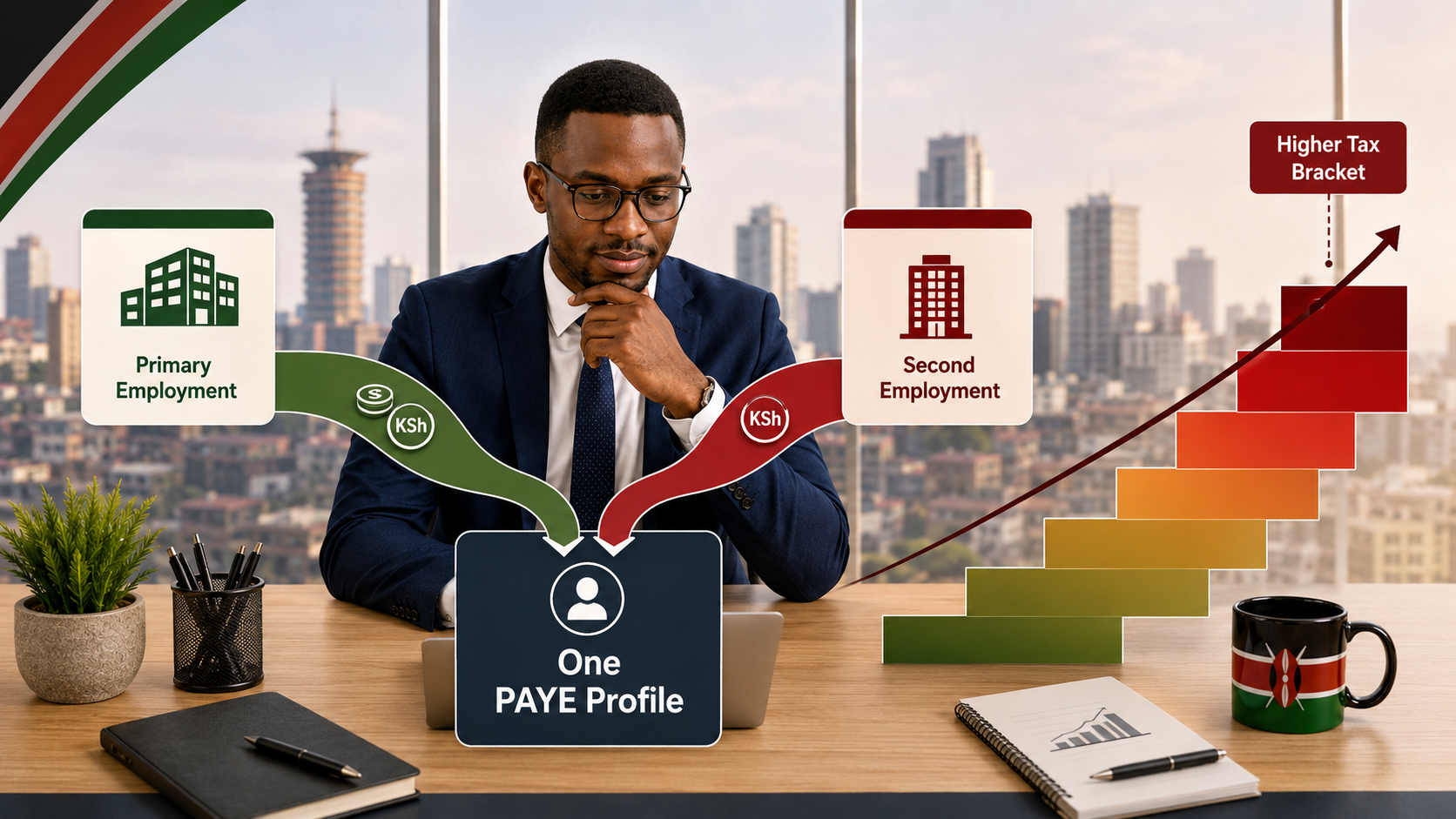
In today’s economy, one payslip is no longer enough for many Kenyans. A teacher may lecture part-time. An accountant may sit on a board. A data analyst may consult on weekends. A pastor may earn employment income from a church and also teach at a college. In short, Kenyans are working hard sometimes so hard that even the payslip needs a spreadsheet.
But there is one tax issue that often surprises employees with more than one employer: income from a second employer may not be treated the same way as income from the primary employer for PAYE purposes.
The result is a common question: Why does my second job appear to suffer more PAYE than my main salary?
The answer lies in how Kenya’s PAYE system works.
PAYE is deducted by employers, but income tax belongs to the individual
Kenya’s PAYE system places the duty to deduct and remit employment tax on the employer. KRA states that any person who pays emoluments to employees is required to register for PAYE, deduct tax from employees’ emoluments, and remit the tax to KRA.
However, income tax is ultimately assessed on the individual taxpayer. KRA explains that individual income tax is charged on all income of a person, whether resident or non-resident, that accrued in or was derived from Kenya.
That creates the core problem.
Your primary employer sees your main salary. Your second employer sees only what they pay you. But KRA eventually sees your total income through your annual return, P9 forms, employer declarations, and other income records.
In other words, each employer may run payroll separately, but the taxpayer has only one tax identity.
Why the second employer income is different
Kenya uses progressive income tax bands. From 1 July 2023, the monthly bands range from 10% to 35%, and resident individuals are entitled to personal relief of KSh 2,400 per month, or KSh 28,800 per year.
Progressive tax means the first portion of income is taxed at a lower rate, and higher portions are taxed at higher rates.
That works neatly when someone has one employer. The employer applies the monthly tax bands, deducts applicable reliefs and deductions, and remits PAYE.
But when a person has two employers, a practical question arises:
Should the second employer treat the second salary as if it is the employee’s first income of the month?
If the answer is yes, the employee may enjoy the lower tax bands twice. If personal relief is also applied twice, the employee may receive a double benefit that does not reflect their true annual tax position.
That is why second-employer PAYE has historically been treated cautiously. KRA’s Employer’s Guide recognises employees with two or more PAYE income sources, such as several directorships or part-time employments, and states that monthly personal relief should be granted by the employer at the employee’s main source of employment income.
Put simply: the second income is not suspicious income; it is additional income.
And additional income often sits higher up the tax ladder.
A simple example
Assume an employee earns:
| Source | Monthly income |
|---|---|
| Primary employer | KSh 100,000 |
| Second employer | KSh 30,000 |
| Total monthly income | KSh 130,000 |
If the second employer treats the KSh 30,000 as the employee’s only income, part of it may fall into the lower 10% and 25% bands, and personal relief may reduce the tax further.
But economically, that KSh 30,000 is not the employee’s first KSh 30,000 of the month. It comes after the KSh 100,000 already earned from the primary employer.
That means the second income may properly fall into a higher marginal tax bracket once the employee’s total income is considered.
This is why many employees feel a “payslip shock” when they receive income from a second employer. The money is real. The effort is real. Unfortunately, the PAYE is also very real.
The fairness argument
The logic behind the rule is fairness.
Consider two employees:
| Employee | Income structure | Total monthly income |
|---|---|---|
| Employee A | One employer | KSh 130,000 |
| Employee B | KSh 100,000 primary + KSh 30,000 second job | KSh 130,000 |
If Employee B receives the lower tax bands and relief twice, they may pay less monthly PAYE than Employee A, even though both earn the same total income.
That would create a loophole where splitting income across employers reduces PAYE. The system therefore tries to ensure that two taxpayers with the same total income are not treated very differently simply because one has multiple payslips.
In tax policy language, this protects equity.
In ordinary language, KRA is saying: “Nice try, but we can count.”
The compliance risk: multiple P9s, one annual return
The issue does not end at payroll. During annual filing, KRA requires taxpayers with more than one employer to declare income from all employers in a single return.
This is where under-deductions become visible.
If the second employer did not deduct enough PAYE, or if reliefs were duplicated, the employee may discover an additional tax payable when filing the annual return. This can feel unfair because the employee assumed PAYE had already “handled everything.”
But PAYE is only a withholding system. It is not always the final tax position.
The annual return is the reconciliation.
The Finance Act 2025 twist: payroll teams must update their thinking
There is an important current-law nuance.
KRA issued guidance after the Finance Act, 2025, stating that employers should apply all relevant tax deductions, reliefs, and exemptions when computing income tax on employee emoluments. The guidance specifically mentions personal relief for resident employees, insurance relief, mortgage interest deductions, pension contributions, post-retirement medical fund contributions, Affordable Housing Levy, SHIF contributions, and valid exemption certificates where supported and within statutory limits.
This means employers and payroll software providers should be careful with old blanket statements such as:
“A second employer should never apply any relief or deduction.”
The safer position is this:
Second-employer income must be handled in a way that prevents double benefits, but employers must also comply with the latest law and KRA guidance on allowable deductions, reliefs, and exemptions.
In other words, the policy objective remains the same: avoid under-taxation and duplication. But the payroll mechanics must be aligned with current law.
What employees should do
Employees with more than one PAYE income source should not wait until June to discover surprises.
They should:
- Inform employers where necessary about other PAYE income sources.
- Keep all P9 forms.
- Confirm whether reliefs and deductions have been applied correctly.
- Declare all employment income in one annual return.
- Review the return before submission instead of assuming pre-filled data is always complete.
This is especially important for professionals with board allowances, part-time teaching income, consultancy arrangements structured as employment, or multiple directorships.
What employers should do
Employers should configure payroll carefully where they know an employee has another main employment.
They should also keep proper documentation for deductions and reliefs applied. KRA’s 2025 guidance places emphasis on accurate and timely PAYE returns reflecting all applicable reliefs, deductions, and exemptions.
Payroll teams should not treat second-employer cases casually. A wrong payroll setup can create problems for the employee and compliance exposure for the employer.
The bigger lesson
Kenya’s PAYE system does not punish second jobs. It simply struggles with a modern labour market where one person may have several income streams, several employers, and one KRA PIN.
The second employer’s income is not different because it is less legitimate. It is different because it is usually not the beginning of the taxpayer’s income story.
The primary employer may be where the lower bands and reliefs start. The second employer is often where the taxman says:
“We have already met you somewhere else this month.”
That is the real lesson. In Kenya’s PAYE system, your second job may be new to your second employer — but it is not new to your tax profile.
Fiscal Prizm takeaway
The next time someone complains that their second job has been “taxed too much,” the answer may not be that the employer is wrong. The answer may be that Kenya’s PAYE system is trying to tax the person’s total income fairly, even though the income arrives through different payroll doors.
The practical challenge is transparency. Employees need clearer explanations. Employers need better payroll controls. Payroll software needs smarter multi-employer logic. And taxpayers need to understand that when it comes to PAYE, a second payslip does not mean a second tax-free start.
